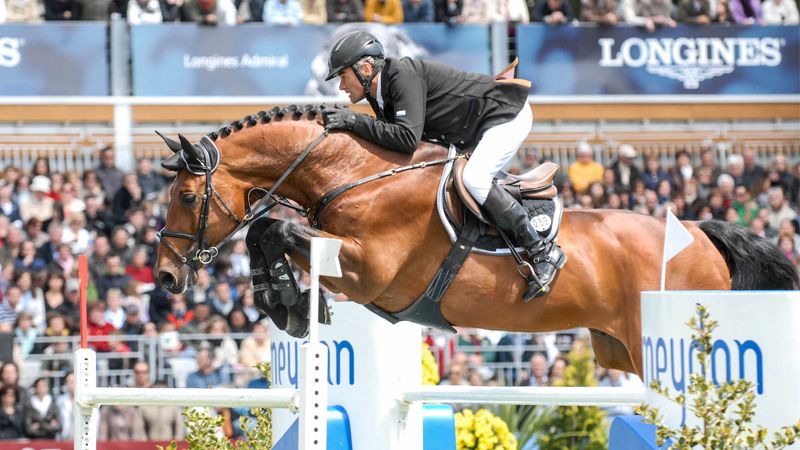

In modern sport horse breeding, the number of offspring alone no longer tells the full story. A stallion may produce hundreds—or even thousands—of horses, but how many of them actually reach the highest levels of the sport?
To answer that question, we analyzed the current ranking of stallions aged 15 years or older based on their percentage of black-type offspring. To avoid distortions caused by small populations, only stallions with more than 100 offspring aged eight years or older were included.
The result is a fascinating list of proven sires whose offspring have had ample time to demonstrate their value in international sport.
Chacco Blue remains the benchmark
At the top of the ranking stands Chacco Blue, a stallion whose influence on modern showjumping breeding is difficult to overstate. With more than 3,000 offspring aged four years and older, he combines scale with exceptional quality:
- 60.0% black-type horses
- €4.4 million in total prize money
- Average earnings of €33,674 per successful offspring
What makes Chacco Blue remarkable is not simply that he produces top horses—it is the consistency with which he does so. Even after years at the top of breeding rankings, his offspring continue to dominate the sport worldwide.
The new generation is already knocking on the door
While Chacco Blue leads the ranking, several younger stallions are rapidly establishing themselves among the elite. Etoulon VDL ranks second with an impressive 55.2% black-type offspring, while HH Messenger follows closely at 52.5%.
These stallions have considerably smaller populations than the established giants, yet their percentages suggest an extraordinary concentration of quality.
The same applies to:
- Comme il Faut (51.8%)
- Casallco (50.3%)
- Cascadello I (49.3%)
All three have already produced large numbers of international performers and are increasingly proving their value as long-term breeding influences.
Quality versus quantity
One of the most interesting observations is how differently stallions can arrive at similar black-type percentages.
Take Cornet Obolensky as an example.
With more than 5,100 offspring aged four years and older and over 800 offspring aged eight years and older, he has by far the largest population in the ranking.
Yet despite that enormous scale, he still achieves:
- 48.8% black-type horses
- €7.6 million in total prize money
Maintaining such a percentage across thousands of offspring is arguably even more impressive than achieving it with a smaller population.
A similar story can be seen with:
These stallions combine substantial numbers with consistently strong results, proving that quality can be maintained even when breeding on a large scale.
The veterans refuse to disappear
Several legendary stallions continue to justify their reputation decades after the first offspring entered sport.
For Pleasure, Nabab de Rêve, VDL Cardento, and Luidam all remain among the top 20 despite belonging to an older generation of sires.
Particularly noteworthy is VDL Cardento.
Although only 40% of his offspring become sport horses—a relatively modest figure compared with some modern sires—those that do compete are exceptionally successful:
- 44.0% of those are black-type horses
- 4.4% black-type winners
- Average earnings of €25,517
Likewise, Luidam boasts the highest black-type winner percentage in the entire ranking at 4.5%, highlighting his ability to produce true winners at the highest level.
Beyond sport horses: producing elite performers
Another interesting pattern emerges when comparing sport horse percentages with black-type percentages.
Nabab de Rêve is a perfect example. Only 41.2% of his offspring become sport horses, one of the lowest figures in the ranking. Yet among those that do compete, an extraordinary proportion reaches black-type level, resulting in a black-type percentage of 45.5%.
This suggests that while he may produce fewer competitors overall, those that do make it into sport often possess exceptional quality.
The same phenomenon can be observed with VDL Cardento and Thunder van de Zuuthoeve, both stallions known for producing horses capable of competing at the very highest level.
What does this tell us?
Perhaps the biggest lesson from this ranking is that breeding success is about more than producing large numbers of horses. Some stallions excel through sheer volume and consistency, such as Chacco Blue and Cornet Obolensky. Others achieve their reputation through an exceptional concentration of top-level performers, such as Etoulon VDL, HH Messenger, and Casallco.
By focusing on black-type percentages and restricting the analysis to stallions with substantial offspring numbers, we get a clearer picture of true breeding influence.
And ten years after many of these stallions first entered the breeding spotlight, one conclusion stands out:
The greatest sires are not simply those that produce sport horses—they are the ones that consistently produce elite sport horses. You can see the full ranking here.