
The search for the next generation of top sires is always a fascinating exercise. While established names dominate the rankings, it is at least as valuable to look ahead. Which younger, still relatively “unproven” stallions are on their way to the very top?
For this analysis, we deliberately focus on stallions born in 2010 or later. Moreover, we look not only at absolute numbers, but especially at efficiency: the percentage of black type offspring — horses competing at 1.45m level or higher. Only offspring aged 8 and older were taken into account to provide a fair comparison.
Dominator 2000 Z and others: strong numbers, strong representation
When looking purely at numbers, Dominator 2000 Z (b. 2010) immediately stands out. This son of Diamant de Semilly, who himself competed successfully at 1.65m level under Christian Ahlmann, has produced 103 black type offspring out of 240 horses aged 8 and older. That equals 43% — a strong figure. He already ranks 15th in the overall standings.
Casallco (Casall x Contender, b. 2011) is equally impressive. With 81 black type horses out of 156, he reaches an excellent 52%, confirming his reputation as one of the most promising sires of his generation.
Further down the list we find Grandorado TN N.O.P (Eldorado van de Zeshoek x Carolus H), who achieves 49 out of 111 offspring at black type level, resulting in 44.1%. Stallions such as Candy de Nantuel with 29 out of 121 (24%) and Grand Slam VDL with 27 out of 72 (37.5%) also show they are steadily making their mark.
However, while absolute numbers matter, percentages often tell an even more powerful story.
The real standouts: exceptional percentages
When we reorder the ranking based on the percentage of black type offspring, the picture changes dramatically — and becomes even more interesting.
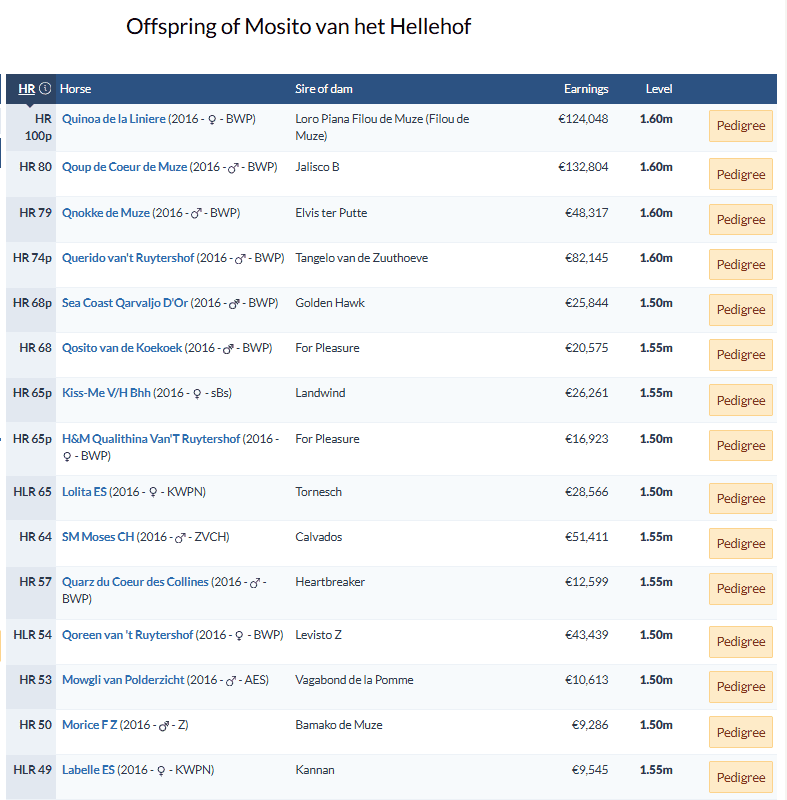
At the very top is Mosito van het Hellehof. This 14-year-old stallion delivers a truly phenomenal performance: 37 of his 43 offspring (aged 8 and older) compete at 1.45m level or higher. That results in an extraordinary 86%. In this context, that is not just exceptional — it is astronomical and a clear indication of an outstanding sire.
In second place is Kassander van het Roosakker, with 22 out of 29 offspring reaching black type level, resulting in an impressive 76%. Once again, we see a stallion consistently passing on his genetic quality.
Third place goes to El Torreo de Muze with a strong 58.6%, closely followed by De Flor 111 Z Santa Rosa (56%).
Just behind them is a group of stallions all exceeding 50%:
- Kasanova de la Pomme – 55.6%
- Casallco – 52%
- United Touch S – 51.5%
- Corydon van T&L – 51.1%
The most striking trend? There is no single dominant “formula” — and that’s exactly what makes it interesting.
Where one might expect a handful of dominant bloodlines, studbooks, or stallion types to prevail, this analysis shows the opposite. Both in the ranking by numbers (with Dominator 2000 Z, Casallco and Grandorado TN N.O.P.) and by percentages (with Mosito van het Hellehof, Kassander van het Roosakker and El Torreo de Muze), we see a remarkably diverse group of stallions.
Pedigrees vary widely, and the stallions originate from a broad range of studbooks: BWP, KWPN, Selle Français, Holstein, Westphalian… This indicates that today’s top sires no longer come from a single “hotspot,” but that the genetic foundation of showjumping has become very broad. Quality is spread out — offering breeders opportunities to succeed with different strategies.
What does subtly return are a few influential sire lines. Names such as Heartbreaker, Nabab de Rêve and Diamant de Semilly appear repeatedly across pedigrees. Not as dominant forces, but rather as recurring anchors within this wide genetic diversity.
In short: The modern top sire is not the product of a single formula, but of a broad, international genetic mix — with a few proven foundations that continue to reappear.
View the full ranking here.