
The Hippomundo Ratings (HR) provide an up-to-date picture of show jumpers active in the sport today. Every horse with a HR score has recently competed at competition level. But who predominates in the sport: male (stallions and geldings) or female (mares) horses?
Based on two data sets, we looked at the gender distribution at different levels:
-
Horses between 8 and 25 years of age that ever jumped the highest level (level 1.60m).
-
All sport horses with a HR score at all levels, from 5 to 25 years of age.
Note: In the first analyses we do not distinguish between stallions and geldings - both fall under “male”. In a final section we do zoom in on this.
Mares are underrepresented at the highest level
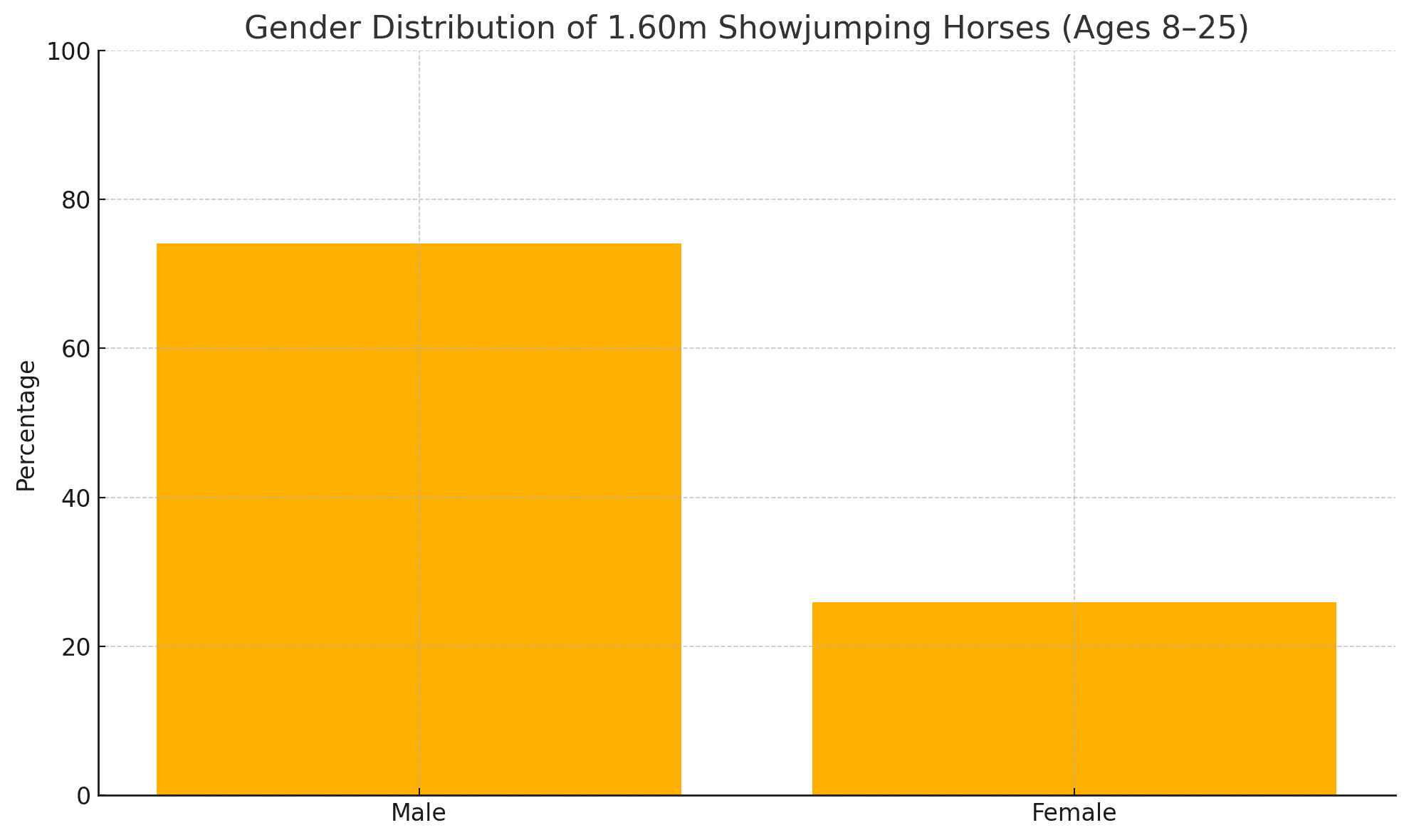
Of the 2733 jumpers who ever jumped 1.60m, a whopping 74% are currently male and only 26% are female. This difference is strikingly large.
This lopsided ratio can be partly explained by the use of mares in breeding. Successful mares are often withdrawn from the sport at a young age, while male horses - certainly geldings - tend to remain active for longer.
Distribution level 1.60m horses by age and gender
| Age | Total | Male | Top HR male | Female | Top HR female |
|---|---|---|---|---|---|
| 8 | 3 | 3 | Haristo du Gue | 0 | – |
| 9 | 55 | 42 | Lorenzo ES | 13 | Qalista DN |
| 10 | 196 | 123 | Ping Pong van de Lentamel | 73 | Casual DV Z |
| 11 | 291 | 194 | Point Break | 97 | Toulayna |
| 12 | 363 | 263 | Imagine N.O.P. | 100 | Hello Chadora Lady |
| 13 | 399 | 284 | Cayman Jolly Jumper | 115 | Mila |
| 14 | 415 | 312 | Blood Diamond Du Pont | 103 | Priam du Roset |
| 15 | 345 | 249 | King Edward | 96 | Killer Queen VDM |
| 16 | 308 | 245 | Monaco N.O.P. | 63 | Visconti Du Telman |
| 17 | 176 | 149 | Vitiki | 27 | H&M Indiana |
| 18 | 94 | 80 | QH Alfons Santo Antonio | 14 | Oaks Milky Way |
| 19 | 53 | 48 | Catch Me Not S | 5 | Quitana 11 |
| 20 | 26 | 25 | Rokfeller De Pleville | 1 | Corsica |
| 21 | 7 | 6 | Unique d'Elbé | 1 | Calida 55 |
| 22 | 1 | 1 | Cash In | 0 | – |
| 25 | 1 | 1 | Calle | 0 | – |
At the lower levels, the gender gap is less pronounced.
When we look at the entire sport population across all levels, we see a much more balanced distribution. Of the 56,998 sport horses, 57% are male and 43% are female.
Mares are thus more widely represented in the lower and intermediate levels of the sport. That difference from the 1.60m population suggests that female horses are less likely to advance to the top, despite a solid presence across the board.
Distribution of sport horses (all levels, age 5-25 years)
| Age | Total | Male | Female |
|---|---|---|---|
| 5 | 3476 | 1880 | 1596 |
| 6 | 5582 | 3120 | 2462 |
| 7 | 7647 | 4199 | 3448 |
| 8 | 7922 | 4380 | 3542 |
| 9 | 6902 | 3814 | 3088 |
| 10 | 5658 | 3067 | 2591 |
| 11 | 4631 | 2653 | 1978 |
| 12 | 3953 | 2369 | 1584 |
| 13 | 3456 | 2070 | 1386 |
| 14 | 2506 | 1536 | 970 |
| 15 | 2000 | 1220 | 780 |
| 16 | 1464 | 969 | 495 |
| 17 | 911 | 643 | 268 |
| 18 | 476 | 348 | 128 |
| 19 | 228 | 162 | 66 |
| 20 | 108 | 79 | 29 |
| 21 | 41 | 30 | 11 |
| 22 | 19 | 13 | 6 |
| 23 | 10 | 7 | 3 |
| 24 | 5 | 3 | 2 |
| 25 | 3 | 2 | 1 |
Exceptional performers: who scores highest?
Of the horses with a HR score higher than 100 - an indication of exceptional performance at the international level - we did look at the distinction between geldings, stallions and mares.
There were a total of 160 horses with scores above 100, distributed as follows:
Despite the commercial value of stallions and the breeding efficiency of mares, it is mainly the ** geldings that most often score above 100 in terms of consistency and performance**. This underlines their reputation as reliable sport horses that often continue to perform at a high level for a long time.
How old are active sport horses on average?
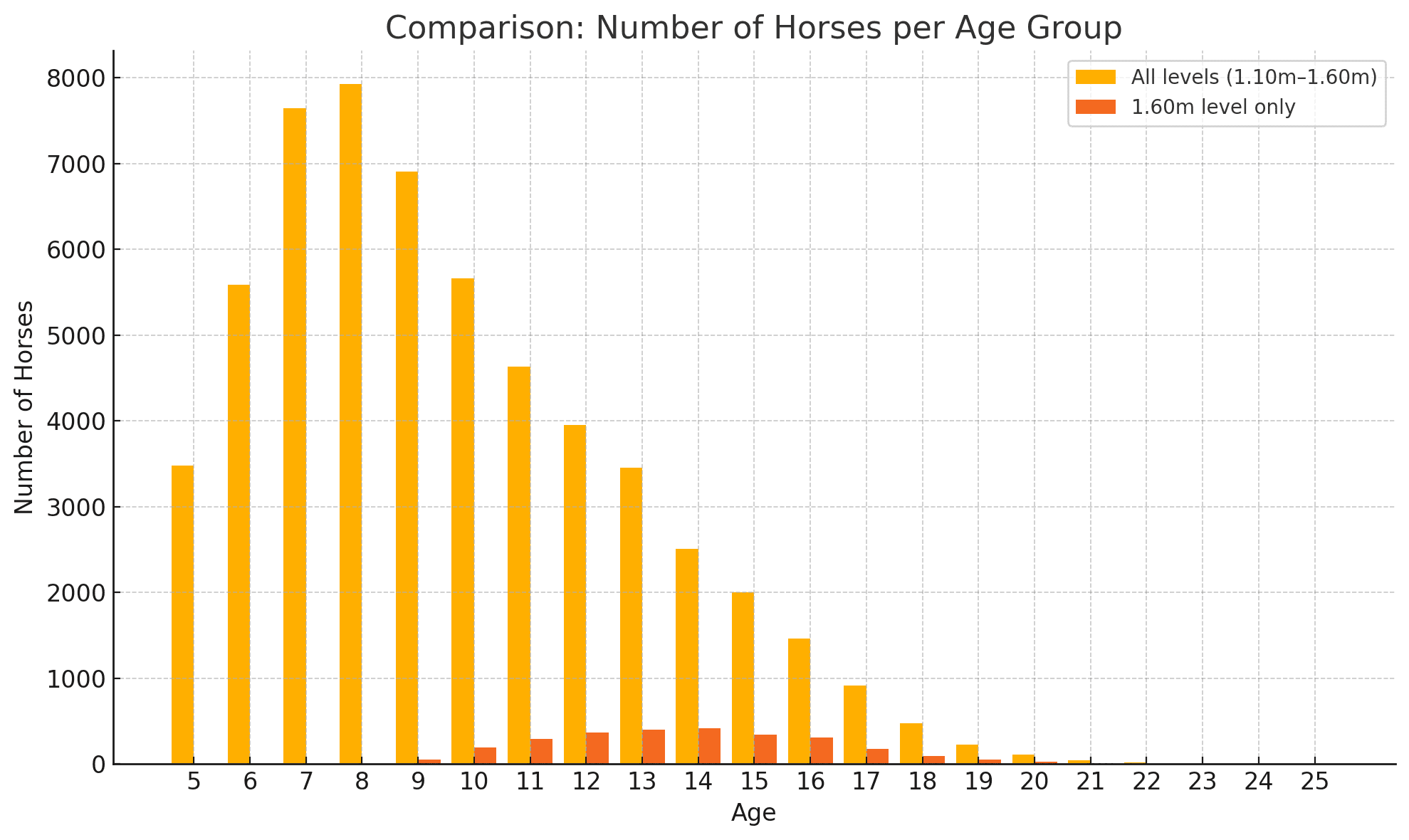
From the previous data, we also get a picture of the sport population, which across all levels consists mainly of horses 7 to 12 years old, with a clear peak at 8 years. Level 1.60m horses are especially strongly represented between 11 and 14 years of age.
Conclusion
The numbers confirm what many insiders already suspected: male horses dominate the sport, especially at the highest level. Yet the proportion of female sport horses is significant in the lower classes.
Thus, the gender distribution in sport is not a matter of talent, but of commercial and breeding choices. This makes top performances by mares such as Killer Queen VDM, H&M Indiana or Mila all the more remarkable - they are the exceptions that prove the rule.