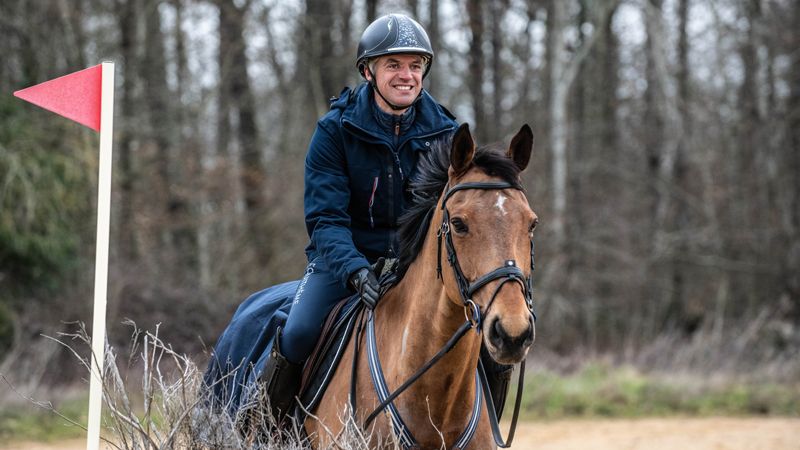
Karim Laghouag has been a pillar of the French Eventing Team for many years. Team Olympic Champion in Rio in 2016 with Entebbe de Hus, he is preparing for the 2021 Olympic Games with Triton Fontaine. He opened the doors of his stables to us and answered our questions about the year 2020, his programme for the coming months and the young horses he believes in for the future.

How did you experience the year 2020?
We put ourselves in our shell a little, like a snail. We went inside and didn't dare to stick our heads out too much. We tried to do the competitions that we were allowed to do, even if we were a bit limited. When we came out we were all hungry as hell. We were super ready because we were waiting for it. After, we found ourselves in the unknown again. The situation also allowed us to discover other things. We realised that we only live for the competition, only for the competition, to keep on improving. This situation, it made us look at ourselves, at our family, spending more time with the children and staying at the stable. It forced us to discover a different life. It's quite confusing but also enjoyable from a certain point of view. Afterwards, the big "advantage" if I may say so, is that it was worldwide. We didn't end up with a single country with the problem, which would have created a performance gap. We all started from the same point when we were able to come back to the sport. This confinement has also been a privilege in terms of contact with the horses, which I don't often have because I'm not often at home. We were at home all the time, so we could spend more time with them. It was different. But hey, we should move on to something else.
Were you annoyed to lose that season with your horses?
For Punch, who is my old horse, it is very annoying because we won't be bringing him back for the Olympic Games one year later. But for Triton, who has only been with me for three years, a fourth year is welcome in spite of everything. After that, we also need to be able to train and compete. Everything is allowed today, but we still have doubts that we will be confined once again, that we can no longer compete or that it would be financially complicated. We still remain in the unknown.

If things go well, what is your programme for this year?
The basis of my programme is the Grand National eventing competition. There are five legs in total. There will be three and the four-star in Saumur to repeat a long event before the Games. It's important that the horses are really in the running. It's important to try to make up a little bit for the time lost in the events that we couldn't run. The Games can only be run halfway through. You have to do a season with "difficult" competitions to be really ready. The selection will be draconian. In reality, all the riders that qualified for the 2020 Games are still qualified, plus those who were able to qualify at the end of the season last year and those who will still qualify until May. There will be a lot of us to choose from and with less spaces to fill since there will only be three of us compared to Rio where we were four. It's going to be tough.
The weather conditions announced for these Games are not usual. How are you preparing for this?
The area where we have our treadmill, we increase the temperature a little with humidity to get the horse used to being in similar conditions. The first time we did one minute, the second time two, the third time three, etc... To try to go up to 15-20 minutes, to get the horse and myself used to it, since he has his treadmill and I have my house bike next door. We do the thing together. He walks. We don't put a slope, nothing. The goal is not to make him make an effort, but to get him used to living with such intense heat. It's something completely new. With Guy Bessat, my physical coach who is very interested in training horses, we have worked this out. It's what we call physiological markers. It's the same in horses as in humans. If you have nothing, it is a discovery and there is an adaptation. Whereas when your body already knows it, it is more soothing and the body panics much less.

So you are preparing Triton Fontaine for the 2021 Olympic Games. What are his greatest qualities?
He's a horse with a lot of willpower, he's very brave, he has a lot of scope and he's very fast. Secondly, he is a horse that never stops progressing. We had 3 years to come together, but in the end it's not much. He has had quite a history before. Changing riders is always a bit complicated. It takes years to get there. This extra year has been quite beneficial for us. He is a horse that I am getting to know more and more. In dressage, walk and trot, he really has the means to compete with the best. He has a gallop that is a bit punished in general and makes us lose a few points, but he has improved a lot last year. We made the choice to improve his walk and his trot, to start with a very high mark, and to try to just "reduce the break" at the canter. This is what is the least penalizing for the horse and which is likely to pay the most in the end. In these faults, he is a bit stiff and sometimes he has trouble turning very tight when he goes fast. When I started with him, it was love at first sight. We immediately won in 3 and 4*, but the last stage was complicated. So we went backwards, we went down to 1* and then back to bigger. Before there was something missing between us, but that's it, now he has full confidence in me. He's a great horse, a good team-mate.
Last week you were at the federal training camp with several horses. How are these courses going? Is it something important?
Already, for the selection, it's better to show yourself correctly when you go to do these training courses. Even if we have known each other for a long time, there is still this pressure. The goal is that they see the horses well. They are also there to do a check at the beginning of the season, to see where everyone is at. The fact is that the majority of the horses were really very good. Again, it's a special year. We're here to fine-tune the dressage and to have a season plan. We have already done a first training camp at Le Lion d'Angers, and there will be a second one mid-February for me, which will take place just before the first Grand National. These are very important moments when we put our finger on what is going well and what is not going well. There is Thierry Touzaint, Serge Cornut, Thierry Pomel and the veterinarian too. Every year, it's the balance sheet. You mustn't fry your cartridges because you mustn't go too fast, but you have to place yourself by being efficient from the beginning. By experience, we all know that it is better to start 10th and finish first than to start first and finish 10th.

To finish, can you tell us about the young future stars from the stables you are counting on for the future?
We have Embrun de Reno (Eliott MC x Tamaris des Etangs) and Dream de Vieve (Calisco du Pitray x Café au Lait). These are two horses that we bought in partnership with owners. Embrun with Guy Bessat who is also co-owner of Triton and us. And Dream, we are several. There is Philippe Lemoine who is also co-owner of Triton, Guy Bessat and us. These two horses both have extraordinary abilities. Very good in dressage, very fast, very good jumpers and with a good physique. There are not many faults. We know more about Embrun because we got him at the end of his 4-year-old year and he has already competed in the 2 finals. He had to do 5 competitions a year, so he is not worn out. I already have many more links with him than with Dream, which I still know little about. Today, we'll have to put ourselves in phase. But there are still many years to go before we get to Paris. They are two great horses, but they still have everything to show. It is not at 6 or 7 years old that we will really know if they are horses to really do the Games. There is willpower, physical resistance and the hazards of life up to that point. It's still the adventure, but it's really something exciting to think that we're going to make a horse that has done almost nothing before then. Even Dream, who may be 8 years old, has done almost nothing before. Jean-Luc Force has already ridden both of them. He has a real crush on Dream, but of course he also likes to ride the other one a lot. Producing a horse all the way up to the Games is a great challenge.