
The leg position of a horse affects the way it moves, the suppleness of movement, the fluidity and the ease of movement.
The ideal position of a horse's legs is auite rare. It is only an image to make a comparison. A deviating position is by no means a wrong position. It depends on the degree of the deviation and whether the horse is hindered in its use. It is true, however, that an abnormal leg or foot position puts extra strain on the tendons and ligaments around the abnormality and the joints are subject to uneven wear and tear, so that the horse can still suffer from the abnormality at a later stage in their life.
A horse can be born with an abnormal limb deformity, but it can also be caused by poor hoof care, wrong grazing habit (grazing foot) or other external factors. If a foal has an abnormal limb deformity it can be corrected up to about 6 months.
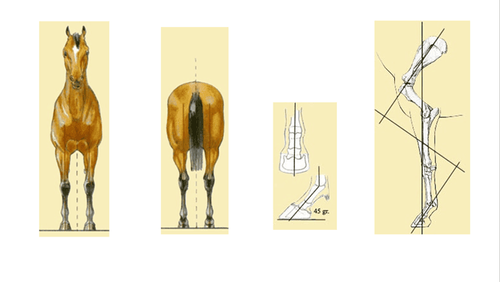
In order to assess a horse's position correctly, the horse must stand squarely on a flat surface. Then you look at the horse from the front, from the back and from the side with the help of the leg axes, an imaginary perpendicular line. Also pay attention to the foot axes, which should be between 45 and 50 degrees.

Side view front legs
1. Normal position
2. Camped out position: the forelegs are placed slightly forward so that the axis of the knee and cannon bone is in front of the perpendicular line. In this position, the rear half of the joints, flexor tendons and ligaments are subjected to extra strain.
3. Standing under: the forelegs are placed slightly backwards, so that they carry a larger part of the body weight than normal.
4. Bucked knees, anterior deviation of the carpal joint: these horses are presented with a forward placement of the knee, which may be related to contraction of the flexor muscles attached to the knee or flexor tendons.
5. Calf knees, posterior deviation of the carpal joint: this is a backwards placement of the knee, which predisposes to lameness from injuries to the carpal bones. This also puts extra strain on the tendons and ligaments and hinders good stability.

Side view hind legs
1. Normal position
2. Camped under: from the pelvis the legs are placed too far forward, which can have adverse effects on the back.
3. Camped out: the legs are placed behind the perpendicular, usually the angle of the hock is also greater than normal and the hooves are standing upright. This position is also detrimental to the back.
4. Sickle hocks, excessive angulation of the hock: the horse appears to be standing with the cannon angled forwards under its body. This position may cause the plantar ligament, which holds the hock and hind cannon together at the back of the leg, to sprain in young horses. This sprain is very painful.

Rear view hind legs
1. Ideal position
2. Base wide: the legs are wide apart and outside the perpendicular. The hooves are crooked and the inner half is smaller than the outer half. The hock joints experience irregular wear and tear.
3. Base narrow: the legs are close together, the distance between the hooves is less than one hoof width. The support surface is narrow, which causes irregular wear of the joints and increases the chance of brushing up against eachother.
4. Tarsal Valgus, cow-hocked and spay-footed: the heels are slightly inward and close together while the hocks are within the perpendiculars. The legs are turned outwards so that the hooves are also turned outwards. This causes the weight of the horse to be distributed irregularly in the hock.
5. Pigeon toed: occurs less often in the hind legs.
6. Cow hocked: the horse's hocks are closer together than normal and usually the lower leg is also displaced outwards. It leads to additional strain on the tendons and ligaments around the joint.

Side view hoof angles
1. Ideal position: the ideal foot position forms an angle of 45-50 degrees with the ground, however, it is quite rare for horses to meet these conditions in all four legs.
2. Sloped foot: the foot axis is less than 45 degrees, leading to extra wear and tear, especially on the flexor tendons and a weak constitution of poorly developed muscles and joints.
3. Stumpy foot: the foot is at an angle of more than 50 degrees to the ground. This reduces the impact of the hoof coming down on the ground, leading to wear and tear on the joints.
4. Broken back: the imaginary foot axis is broken backwards, leading to extra wear and tear of the bending tendons, ligaments and tendon sheaths.
5. Combination of a broken forward foot axis and a sloped leg, this position is detrimental to good movement.
6. Broken forward: the imaginary foot axis is broken forward with a steep hoof. This leads to extra wear and tear of the flexor tendons, ligaments and tendon sheaths on the posterior surface of the foot joint. This skewed position can also lead to shoulder and/or back problems.