

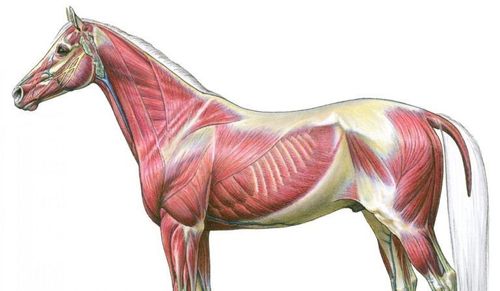
What do you actually know about your horse's body? As a horse owner, it can be very beneficial to have some basic knowledge of the anatomy of a horse.A better knowledge of a horse's anatomy can provide a better understanding their locomotion on which you can base your training schedule. This is why we decided to briefly illustrate the muscular system of a horse.
Definition and function
A muscle (Latin: musculus) is a soft tissue structure that can contract which make movement possible. Muscles can only exercise tensile force.
The most important functions of muscles is to make movement possible, maintain physique, stabilise joints and emit heat after contraction.

Structure of the muscle
A muscle is made up roughly out of three parts (exterior to interior):
The biggest part is the muscle belly. This is the part of the muscle that contains the muscle fibres, where the muscle contracts, which is what we perceive as movement.
Then there is the origin. The origin is a tendon which attaches the muscle to a "fixed", motionless bone in the body, for example that shoulder blade.
Finally there is insertion. This is where the muscle attaches to a mobile bone, like the underarm. Just like the origin, the insertion is a tendon.
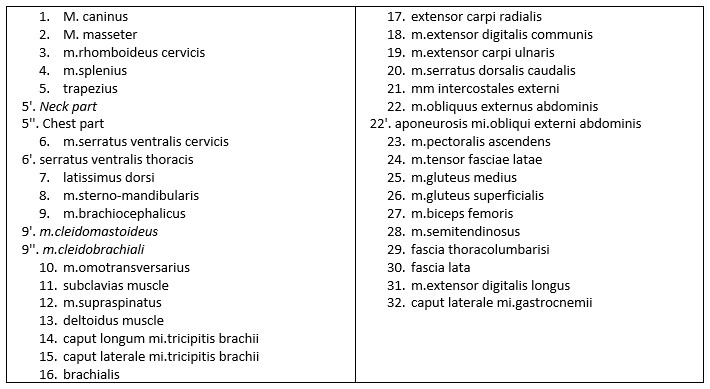
Classification of the muscles
Distinction based on control:
-Voluntary muscles: these muscles are consciously set in motion
-Involuntary muscle: these muscles aren't consciously controlled, for example the gut
Distinction based on function
-Extensors
-Flexors
-Abductors
-Adductors
-Pronators: internal rotators
-Supinators: external rotators
Distinction based on their relationship in movement
-The agonist is a muscle which is primarily responsible for the movement, for example the m. biceps brachii in the movement of the arm in the elbow
-The antagonist is a muscle which is responsible for the execution of the opposite movement, in aforementioned example that would be the m. triceps brachii.
-The synergist is a muscle which contributes to the establishment of the movement, in aforementioned example that would be the m. brachialis.
These three expressions are relative, which means they only carry their name in a specific situation. A correct statement would be: "the m. biceps brachii and the m. triceps brachii are antagonists." Or " the m. biceps brachii and the m. brachialis are each other's synergists".
Distinction based on tissue
-Skeletal or striated muscle tissue
-Cardiac muscle tissue
-Smooth muscle tissue
Distinction based on myoglobin levels:
-Fast twitch or bleak muscle, low in myoglobin
-Slow twitch or red muscles, high in myoglobin
For more information on a horse's muscular system, go to http://www.paarden-blaadjes.nl/paard/spieren.html